
 Back to All Performance Assessments
 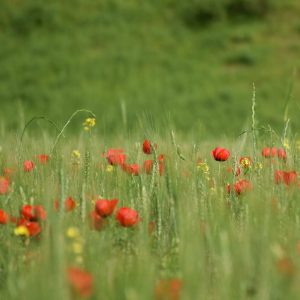 Image copyright: Asal Lotfi/via Unsplash
Wheat
 Netherlands
The system under trial is conventional organic wheat production in the Netherlands
Performance assessment
To understand how strip cropping and other diverse crop management strategies affect herbivore, weed and disease pressure.
| Common name | Scientific name | Pest type |
|---|---|---|
|
Dandelion |
Taraxacum officinale |
Weeds |
|
Thistles |
Cirsium spp. |
Weeds |
|
Redshank |
Persicaria maculosa |
Weeds |
|
Yarrow |
Achillea millefolium |
Weeds |
|
Chamomile |
Matricaria chamomilla |
Weeds |
|
Senecio spp. |
Senecio spp. |
Weeds |
Standard practice:
Organically grown monoculture field of wheat (3500m2)
Herbicides: Clopyralid, Florasulam, Fluroxypyr meptyl
Adopt-IPM solution:
16-meter-wide strip cropping of wheat with grass-clover, and
3-meter-wide strip cropping of wheat with seven other crops (early and late potato, onion, carrot, faba bean and grass-clover).
Experimental design
Incomplete block design. Two locations, Wageningen and Lelystad, with at least two blocks each including all Strip treatments. Also, a large-scale monoculture per crop is included.
(See Figures)
Replications
Two locations, with 3 (Wageningen) and 1 (Lelystad) fields that include all four strip crop designs. These fields include 2 strips per treatment in which measurements take place.
Plot size
One strip is about 3 * 55 meters. Monocultural field is about 3500 m2.
Trial Duration
Planned start date: 2023 Planned end date: 2025
Location
Both locations are managed organically without the use of biological or chemical pesticides. The fields in Wageningen are located north of the Wageningen University campus (51°59’24″N, 5°39’36″E, 13 masl), as part of a larger network of experimental fields. The soil type is loamy sand. The surrounding landscape is quite diverse with many relatively small experimental fields (<5 ha) and semi-natural habitats like tree lines and ditches. The experimental fields are enclosed by other smaller experimental plots of Wageningen University to the south, a small-scale farm to the west, larger experimental fields to the north, and a busy regional road to the east.
The fields at Lelystad are located east of the city of Lelystad at the Wageningen Research Field Crops location (52°32’33″N 5°34’23″E, -4 mbsl). The soil type here is sandy clay loam, claimed from the sea in 1957. The surrounding landscape consists mainly of larger scale experimental fields (5 – 10 ha) and large-scale agriculture (10 – 40 ha), with some small semi-natural habitats throughout the landscape, like small waterways and flower strips.
Randomization Procedure
The four strip crop design treatments are randomly assigned in stripcropping fields. The reference monoculture oat and cabbage crops (standard practice) rotate to different fields according to the crop rotation (see also experimental layouts of the Wageningen and Lelystad trial sites).
Sample Size Justification
We maximized the number of sample size within the available budget and labour constraints.
Data Collection
Clip cages and camera trapping of aphids and their natural enemies. Two years of data have been collected in multiple strip cropping designs (in 2023 and 2024). In 2025, at least measurements will be taken in the monoculture and simplest strip cropping design. Potentially we will also still sample in the other strip cropping designs, but this is not decided yet.
Statistical Methods
Most data will be analysed using General(ized) Linear (Mixed) Models.
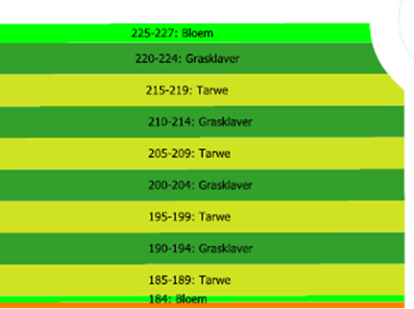
Experimental design: Figure 1
© Wageningen University
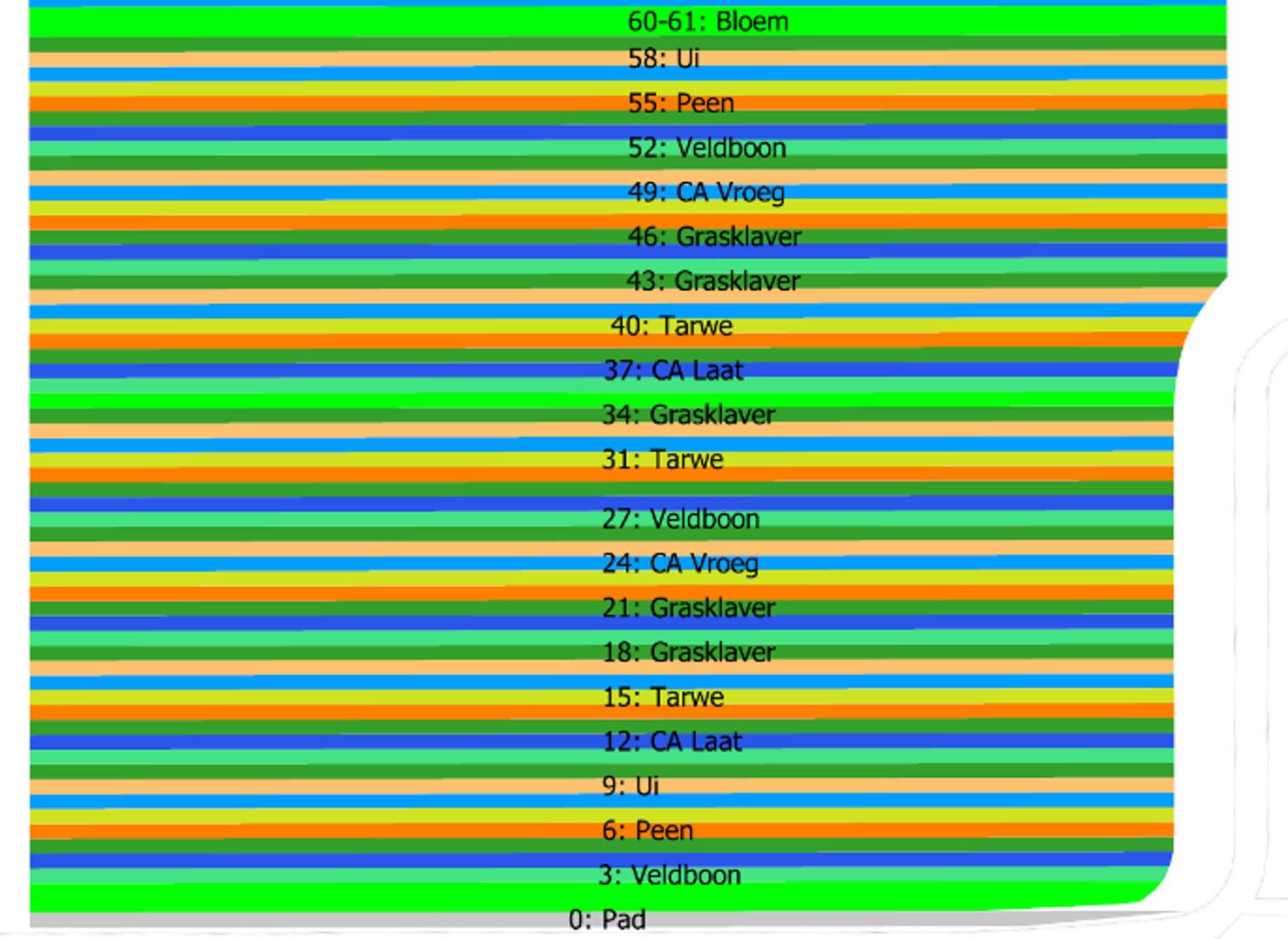
Experimental design: Figure 2
© Wageningen University
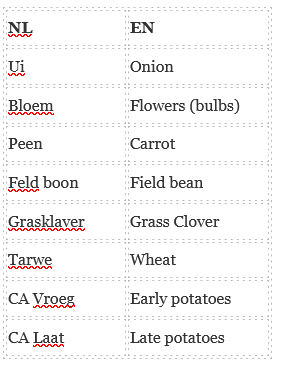
Translations for figures
© n/a
Overall Performance
Packages are compared by their Performance (displayed in the bar charts and summarised by the Utility score) and their Pesticide Load Index (PLI). Higher Performance/Utility and lower PLI indicate more favourable results.
Compare Packages
| Package | Utility | Pesticide Load Index |
|---|---|---|
|
Baseline |
95% |
- |
|
ADOPT-IPM |
70% |
- |
Summary
The current commercial package is effective and economically acceptable at managing losses due to weeds. The ADOPT IPM package is slightly less effective, more expensive and requires more time and coordination to deliver. It does however, deliver better environmental outcomes.
Performance by indicator
Compare Packages
| Package | Utility |
|---|---|
|
Baseline |
98% |
|
ADOPT-IPM |
74% |
Notes
The CCP delivers low losses as would be expected – with good confidence in these results. The ADOPT IPM package delivers lower yields as space is required for the strips although yield per unit area are probably similar. Some edge effects along strips leads to some yield reduction.Compare Packages
| Package | Utility |
|---|---|
|
Baseline |
98% |
|
ADOPT-IPM |
95% |
Notes
CCP is low risk as most work is done using tractors. ADOPT IPM package involves manual removal of some tussocky weeds at the start so some minor risks here.Compare Packages
| Package | Utility |
|---|---|
|
Baseline |
98% |
|
ADOPT-IPM |
27% |
Notes
CCP provides a system for growing crops profitably under current regulations. ADOPT IPM package requires investment in mechanical hoes and many more entries into the field, typically 4-5 passes compared to 2 spray applications. This leads to increased machinery, fuel and labour costs.Compare Packages
| Package | Utility |
|---|---|
|
Baseline |
74% |
|
ADOPT-IPM |
95% |
Notes
CCP relatively low GHG emissions with only two spray applications. ADOPT IPM leads to greater insect biodiversity within the strips and probably soil biology too. However, the additional passes from hoeing will increase GHG emissions.Compare Packages
| Package | Utility |
|---|---|
|
Baseline |
96% |
|
ADOPT-IPM |
50% |
Notes
CCP is simple and well understood so easy to manage and deliver. ADOPT IPM is more knowledge intensive and time consuming and requires regular crop scouting to decide on actions. Timing of sowing of multiple crops in dry or wet seasons may be difficult to time efficiently.Compare Packages
| Package | Utility |
|---|---|
|
Baseline |
98% |
|
ADOPT-IPM |
50% |