
 Back to All Performance Assessments
 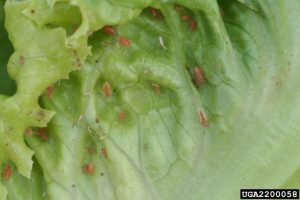 Image copyright: Whitney Cranshaw, Colorado State University, Bugwood.org
Lettuce
 France (South)
Comparing methods of releasing biocontrol (Chrysoperla) to control aphids in lettuce
Performance assessment
The aim of the trial is to compare a biological control strategy for aphids on lettuce using a mass release of Chrysoperla (pulverisation of eggs) with a conventional release strategy. The aim will also be to see whether the introduction of flower strips can optimise chrysoperla release and management of aphids.
| Common name | Scientific name | Pest type |
|---|---|---|
|
Aphid |
Macrosiphum euphorbiae |
Arthropod Pests |
|
Aphid |
Nasonovia ribisnegri |
Arthropod Pests |
|
Aphid |
Aulacorthum solani |
Arthropod Pests |
Standard practice: standard release of Chrysoperla (larvae) and use of spirotetramat two weeks after planting
ADOPT-IPM solution: pulverization (spraying) of eggs on the lettuce
Factor A: release strategy of Chrysoperla with 3 modalities (1 per tunnel)
- No Chrysoperla
- Standard release of larvae
- Pulverization of eggs
Factor B: presence of flower strips with 2 modalities (each tunnel is divided into 2 parts)
- Presence
- Absence
6 modality pairs
Replication
2 replicates of the trial over time
Plot size
3 unheated tunnels (160m2 each)
Trial Duration
Planned start date: March 2024
Planned end date: October 2024
Location
South of France, Baladran Center, CTIFL 751 chemin de Balandran, 30127 Bellegarde
Randomization Procedure
No randomisation, 1 tunnel per release strategy
Data Collection
Number of aphids, Number of Chrysoperla
Statistical Methods
Poisson distribution model for counting variables
Overall Performance
Packages are compared by their Performance (displayed in the bar charts and summarised by the Utility score) and their Pesticide Load Index (PLI). Higher Performance/Utility and lower PLI indicate more favourable results.
Compare Packages
| Package | Utility | Pesticide Load Index |
|---|---|---|
|
Baseline |
90% |
- |
|
Adopt-IPM |
71% |
- |
Summary
The ADOPT-IPM package was not as effective overall as the Current Commercial Practice (CCP). This was largely due to comparatively higher losses, higher direct costs, alongside greater time and management and coordination requirements.
Performance by indicator
Compare Packages
| Package | Utility |
|---|---|
|
Baseline |
95% |
|
ADOPT-IPM |
70% |
Notes
For the ADOPT package, the trial results showed reasonable protection from losses but medium confidence reflected variability in the result due weather, skill, etc. Results become more acceptable for organic production where some level of low infestation is tolerated.Compare Packages
| Package | Utility |
|---|---|
|
Baseline |
74% |
|
ADOPT-IPM |
98% |
Notes
For CCP the slightly increased physical risk compared with the ADOPT packages was attributable to physical discomfort for PPE required for pesticide applications. For the ADOPT package physical risks were negligible.Compare Packages
| Package | Utility |
|---|---|
|
Baseline |
74% |
|
ADOPT-IPM |
50% |
Notes
For CCP, the costs are predictable and well accepted by grower though Spirotetramat is more expensive than other conventional pesticides. In the ADOPT package, CBAs are more expensive (double or triple cost). Flower strip seeds have costs. Flower strips take up growing area. Flower strip irrigation and weeding could add management costs. Chrysoperla costs is more significant that flower stripsCompare Packages
| Package | Utility |
|---|---|
|
Baseline |
98% |
|
ADOPT-IPM |
98% |
Notes
In the ADOPT package, flower strips enhance natural systemsCompare Packages
| Package | Utility |
|---|---|
|
Baseline |
95% |
|
ADOPT-IPM |
50% |
Notes
For CCP, scouting can increase time and management requirements, hence not VH confidence and not everyone uses pest scouting. For the ADOPT package, scouting, planting. purchasing, managing flower strips add to requirements. Extra management requirements may put some growers off adoptionCompare Packages
| Package | Utility |
|---|---|
|
Baseline |
98% |
|
ADOPT-IPM |
30% |