
 Back to All Performance Assessments
 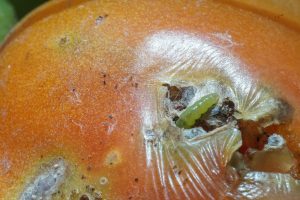 Image copyright: CABI
Tomato
 China (Southern)
Comparing 3MP strategy with farmer practices in managing multiple insect pests on open-field tomato in Yunnan, China
Performance assessment
The objective is to compare the 3MP strategy with local farmer practices in managing several insect pests on tomato from various aspects including pest control efficacy, eco-economy benefits and environmental impacts.
| Common name | Scientific name | Pest type |
|---|---|---|
|
Tomato leaf miner |
Tuta absoluta |
Arthropod Pests |
|
Whitefly |
Bemisia tabaci |
Arthropod Pests |
|
Vegetable leaf miner |
Liriomyza spp. |
Arthropod Pests |
1. Package #1: “farmer practices”: the local commercial practices which are much biased to chemical control for insect pests
2. Package #2: “3MP”: partial replacement of chemical fertilizer by organic fertilizer + companion plants (Verbena hybrid. + Solanum nigrum) + natural population of endemic natural enemies
Experimental design
See figure
Replications
FP (n=5) , 3MP (n=4), control (n=4)
Plot size/number of plants
FP: 6240 plants/2500m2; 3MP: 4960 plants/1985m2; Control: 2080 plants/900m2
Trial Duration
2024.09.10-2025.1.21
Location
Yuan-mou county, Yunnan Province, China
Randomization Procedure
No randomization procedure was done owing to the limitation of fertigation regimes.
Data Collection
(1) Pest management data: insect community dynamics and leaf samples for chemical analyses
(2) Economic data: the costs and benefits of the whole agricultural process (yield per plant, fruit quality and input cost per plant including products and labor)
(3) Ecological data: magnitude of the greenhouse gasses emissions (GHGs), soil health (i.e. microbial community and soil characteristics), and beneficial arthropod abundance
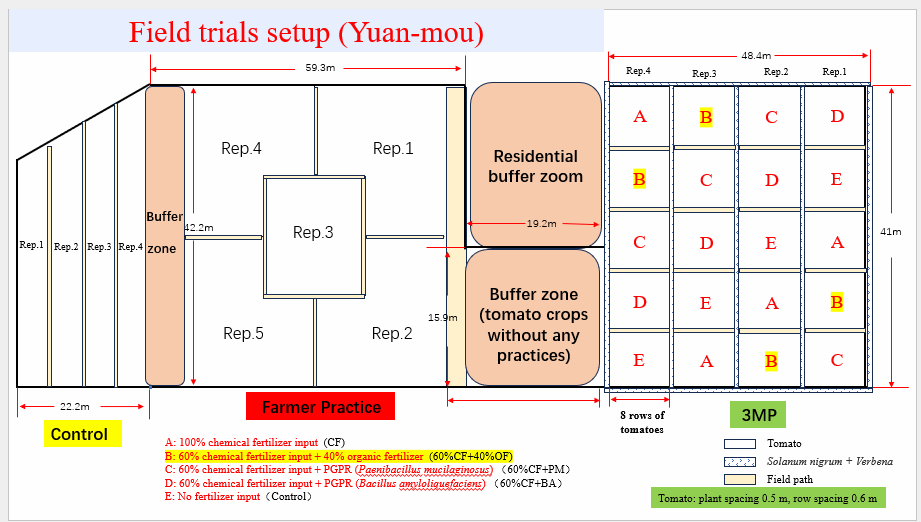
Experimental Design
© Peng Han
Overall Performance
Packages are compared by their Performance (displayed in the bar charts and summarised by the Utility score) and their Pesticide Load Index (PLI). Higher Performance/Utility and lower PLI indicate more favourable results.
Compare Packages
| Package | Utility | Pesticide Load Index |
|---|---|---|
|
Baseline |
66% |
0.20 |
|
ADOPT-IPM |
62% |
0 |
Summary
The overall utility of both the Current Commercial Practice (CCP) and the ADOPT packages were similar. For the IPM package there were higher costs and coordination requirement but the lower environmental impact of the IPM package helped to offset these factors.
Performance by indicator
Compare Packages
| Package | Utility |
|---|---|
|
Baseline |
50% |
|
ADOPT-IPM |
50% |
Notes
Large variation in success of CCP (Farmer practice) because of application (timing, method, etc.). Farmer expertise in insecticide application is important thus medium confidence. The IPM package, did not perform as well as CCP (farmer practice)Compare Packages
| Package | Utility |
|---|---|
|
Baseline |
98% |
|
ADOPT-IPM |
98% |
Notes
There is no difference in the health and safety impacts between the package (when the effect of pesticides is not included, see PLI results for that assessment). For CCP, there were no other risks to consider. For IPM, no significant H&S risks though the environment is more pleasant for workers with the presence of flowersCompare Packages
| Package | Utility |
|---|---|
|
Baseline |
74% |
|
ADOPT-IPM |
50% |
Notes
CCP is well understand and adopted and costs are acceptable. For IPM, organic fertiliser is slightly more expensive that inorganic and slightly more labour is required.Compare Packages
| Package | Utility |
|---|---|
|
Baseline |
70% |
|
ADOPT-IPM |
98% |
Notes
For CCP, society deems regulations may be necessary in the future due to ground water contamination, greenhouse gases, etc. from heavy use of inorganic fetilisers. For IPM, organic fertilisers have lower impact on the environment generally.Compare Packages
| Package | Utility |
|---|---|
|
Baseline |
74% |
|
ADOPT-IPM |
50% |
Notes
Conventional farming practice is more automated and based on calendar pesticide application requiring less time and effort compared to IPM practice, e.g. companion plant management.Compare Packages
| Package | Utility |
|---|---|
|
Baseline |
98% |
|
ADOPT-IPM |
50% |
Notes
For CCP, there is very low need for coordination because of calendar based spraying, no need for scouting, no biocontrol agents required etc. For IPM, growers currently need guidance but in the future the need for coordination will be reduced as farmers adapot to IPM practices. Purchasing of companion plants requires coordination with suppliers.Pesticide Load Index (PLI)
| PLI Sub-Indicator | Baseline | ADOPT-IPM | Notes |
|---|---|---|---|
| Human Health | 0.11 | 0 |
Pesticide Load Index (PLI) is calculated based on the toxicity and the amount of the active ingredient(s) applied as part of each package. A higher PLI indicates higher risk to the relevant sub-indicator (human health, ecotoxicity or environmental fate). Scale from 0-1.5, with 0 being no impact and 1.5 being the highest impact. CCP Societal costs €5.27/ha For the full breakdown of pesticide load and costs, from the Pesticide Impact Explorer tool developed by Aarhus University, click here. |
| Ecotoxicity | 0.30 | 0 | |
| Environmental Fate | 0.20 | 0 |